 Chris Marker (1921-2012) was a prominent of the Left Bank subset of Nouvelle Vague movement, whose essayistic, non-narrative output encompasses a vast cosmos of its own. Marker's short THE PIER (1962) is a heteroclite time-travel experiment marvelously constructed from and concatenated through black-and-white still photos, formally constituting an unnerving ouroboros of one's own fatality not before presciently cautioning audience that humanity can still be saved under its post-apocalyptic milieu.Here are three feature-length documents that spanning 27 years. LETTER FROM SIBERIA is an hour-long colorized ethnocultural reportage of Siberia, its nature, people, customs and the 20th century modernization. A diverting eye-opener garnished with a witty, sometimes even sardonic commentary written by Marker himself and some ingenious divertissements, like the adorable animation sequences about mammoth and a fake TV commercial plugging the utility of a reindeer, joyously jeering the western consumerism. Plus a demonstration of Kuleshov effect (depicting the city of Yakutsk) perceptively hits the mark of how to calibrating a documentary's objectivity. Elsewhere, Marker's missive keeps its distance from engaging with the local denizens, gaping at the ethnic visages and get-ups, intoxicated with their otherness while digressing into other sideshows: the gold rush, the taiga and permafrost, a domesticated bear, just to name a few. Whereas the film is almost guilty as charged for being an outsider viewing and scoping a remote land and culture with a touristic inclination (a go-to approach from a curio-seeking western angle), what Marker achieves with a difference is a stimulating combo of wry humor, alacrity and felicity, emanated from his keen observation, off-kilter erudition and humanistic rumination.
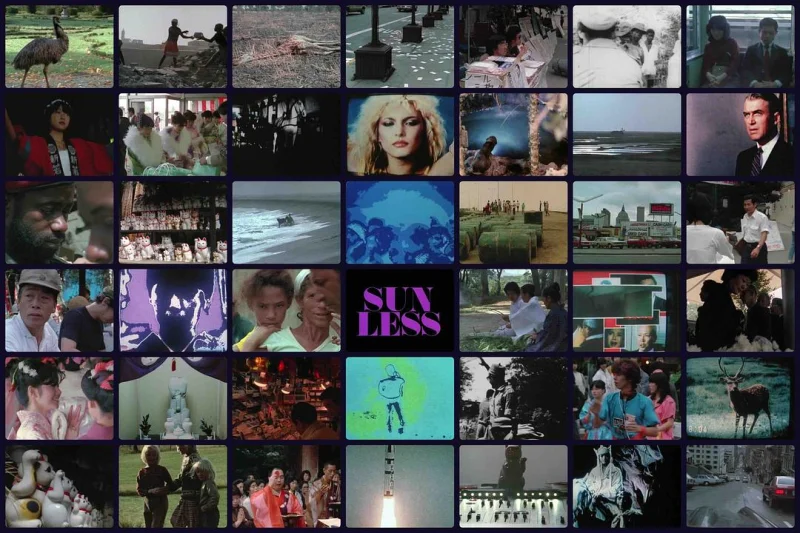
Marker's epistolary philosophizing and pluperfect facility of synchronizing between his texts and imageries come into full bloom 25 years later in SUN LESS, whose title borrows from Modest Mussorgsky's eponymous song circle. Ostensibly a loose travelogue shot by a borrowed 16mm Beaulieu camera, casting a curious look into Japanese culture and life, the film turns out to be far more comprehensive and contemplative. Compiling also footage from Guinea-Bissau, Cape Verde, Iceland, Paris, San Francisco (revisiting the places in Hitchcock's VERTIGO, 1958), some of which are plundered from other artists (the killing a giraffe sequence is disturbingly indelible) and cued by the opening quote"Because I know that time is always time. And place is always and only place." from T.S. Eliot, it is a metaphysical essay on how we navigate our thinking and memories among the spatiotemporal variables. For instance, a montage sequence fluently intercuts between clips of Japanese movies (either scary or erotic) with the faces of passengers napping in the metro, implying their inner, perhaps subliminal thoughts. A mischievous jape nonetheless prompts viewers to ponder over the unfathomable: how one's mind works? Is it an inherently solipsistic process which is privy exclusively to each individual being? Its unknowability makes a fascinating thought. Another snippet about a cat's temple underscores Japan's Shintoism and its reverberations at large, the reverence towards the unknowable, the impermanence. Further integrating Moog synthesizer and avant-garde digital image-visualization to Marker's sonic-optical experiments, SUN LESS establishes itself as an exquisite potpourri of cultural observation and self-involved rumination, and Marker's supernal intellect can guarantee that his keen critique and wide-ranging aperçus are heuristic, thought-provoking, trenchant, anything but navel-gazing.

A.K. is a behind-the-scene documentary about Akira Kurosawa's filming of RAN (1985), his resplendent Sengoku period epic adaptation and transposition of Bard's King Lear shot near Mount Fuji, a high-priced France-Japan coproduction (its budget of $11-12 million made it the most expensive Japanese film in history), which grants Marker a vantage point to closely observe the maestro in action.However, adhering to Marker's trademark essayist methodology, A.K. is not a conventional making-of documentary. There is no talking-heads holding forth on the film they are producing, in fact, there is no interviews whatsoever. Instead, the camera retains a fly-on-the-wall presence, furtively tracking, panning, gazing at the production process and its environs (divided into 10 segments, whose titles ranging from battle, patience, loyalty to horse, fog and rain), focusing on the extras (ultra-close-ups are used to allow them some footage for remembrance as most of them cannot be spotted in the final picture), the elemental forces (against the mountain fog and the impetuous gust), and Kurosawa’s meticulous work ethic (gold-gilt blades of grass, artificial moon). Overall, the documentary goes hard to impress audience with an expeditious, collective labor of love in relation to RAN’s sheer ginormous production scale, and intermittently, sheds some light on Kurosawa’s personalities (conscientious but always kind and sans pretension). These three features (plus one short) are Your’s Truly’s introductions to Marker’s ineffably enlightening, incorrigibly Gallic anthropological universe. His audio-visual creations are a fertile symbiosis of poeticism and lyricism, mundane spectacles and spiritual introspections. By avoiding any intrusive perspective from his subjects, his showing-but-not-telling modus operandi conveys a ceaseless enchantment of his own steam of consciousness that transcends documentary’s message-burdening sobriety and rigidity. His opuses are as freewheeling as his meandering, idiosyncratic, melancholy-free philosophies and insights, which themselves are a seam of nuggets inviting audience to return in his headspace time and again. referential entries: Jessica Kingdon's ASCENSION (2021, 6.1/10); Gregory Monro's KUBRICK BY KUBRICK (2020, 6.4/10); Ingmar Bergman's FÅRÖ DOCUMENT (1970, 7.1/10); Jia Zhangke's I WISH I KNEW (2010, 7.3/10); Agnès Varda's LA POINTE-COURTE (1955, 7.2/10); Alain Resnais's HIROSHIMA MON AMOUR (1959, 8.1/10).

English Title: Letter from SiberiaOriginal Title: Lettre de SibérieYear: 1958Genre: DocumentaryCountry: FranceLanguage: French, EnglishDirector/Writer: Chris MarkerMusic: Pierre BarbaudCinematography: Sacha ViernyEditor: Anne SarrauteRating: 7.7/10English Title: Sun LessOriginal Title: Sans soleilYear: 1983Genre: DocumentaryCountry: FranceLanguage: French, JapaneseDirector/Writer/Music/Editor/Cinematography: Chris MarkerRating: 8.2/10Title: A.K.Year: 1985Genre: DocumentaryCountry: France, JapanLanguage: French, JapaneseDirector/Writer/Editor: Chris MarkerMusic: Tôru TakemitsuCinematography: Frans-Yves MarescotCast:Akira KurosawaRating: 7.3/10


